

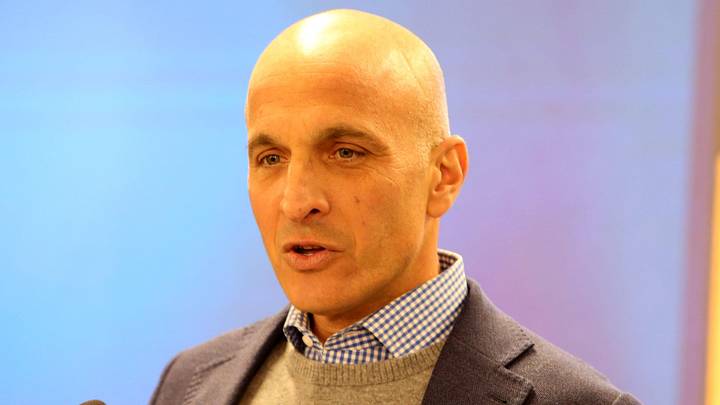
During Wednesday's Senate hearing on the Protect College Sports Act, most testifiers focused on limiting how many times a player could transfer or how much money they could make through NIL. While Notre Dame AD Pete Bevacqua touched on those subjects, his primary focus was on how best to help the Fighting Irish remain competitive in an ever-changing college sports landscape. In other words, the Irish AD wants to change the game regarding the cap currently in place on how much schools can share revenue with their players.
Bevacqua had previously talked about changing the rev-share cap, but this was the first time he took his ideas to the public and in front of the people who might make his plan a rule. During his testimony, he explained that, like many of the other ideas in the bill, his push is driven by what works best for the players. Unlike some of the other aspects of the bill, Bevacqua's wanting to share more money with players is actually in their best interest.
"I've been vocal, and you and I have had conversations over the course of the last few years, but on this particular issue over the course of the last year, I think The House settlement did many good things. I believe that the cap number in the House settlement is too low," The Notre Dame AD said in front of the Senate. "I believe we need to fix a more realistic cap. And I go back to my opening, where there's this misnomer that there's a cap. There is no cap."
Bevacqua meant that while there is technically a revenue-sharing cap for every school (this year set at $21.3 million), there is no actual cap on what a team's roster can earn through NIL. The Irish AD believes that schools like his are at a mandated disadvantage because they have more money to direct towards revenue sharing rather than NIL.
Jack Bevacqua pushes Notre Dame athletics’ revenue-sharing plan in Senate hearing
"Right now, you have a cap outlined by the House settlement, and then you have third-party NIL opportunity. So again, I view it as an equation of X being the cap, Y being the NIL space, equaling the total spend on compensation. I think the more dollars that can be transferred into the cap and paid directly by universities in an incredibly transparent way is going to help clean up the system."
Bevacqua is walking a tight rope regarding revenue sharing. The cap is set where it is because it's supposed to be fair to every school. NIL caps don't exist mainly because the NCAA isn't sure it can tell a player how much he or she can make, as long as whatever deals they strike are approved by the NIL clearinghouse.
“I think the College Sports Commission is doing as good of a job as they can. But I think pushing money into that gray space of third-party collectives and NIL, that’s in my opinion where most of the uncertainty and abuse is,” added Bevacqua. “What I would love to see happen is establishing a realistic cap, and if universities choose to exceed the cap, tying in some form of subsidy on a certain percentage of the dollars."
It's hard to know just how much support the Notre Dame AD's proposal to raise the revenue-sharing cap has in the broader college sports world. He will continue to push for a higher cap until it eventually happens.
 Add us as a preferred source on Google